Tuesday, August 9, 2011

Oh, the Irony

Ladies and gentlemen, I am a record-breaker.

I’m not kidding – prepare to be astounded.  You might want to sit down.

You see, I was the only student ever to win the Home Economics award 3 years in a row at John Jay Middle School (home of the Statesmen, née Indians, which was later determined to be politically incorrect).  I know.  It’s a lot to take in.  Perhaps you should take a minute?


There.  Feeling better?  I’ve often wondered why I was the love object of the Home Ec. department.  So far, the answer seems to be: I was probably the only student who didn’t absolutely hate it.  Because certainly there are more precise cross-stitchers out there.  Better ironers, absolutely.  I recall my 8th grade pillow project turning out a little lumpy.  And don’t tell, but once I think I packed the flour while making baking powder biscuits.

But it’s true, I never hated home ec. – maybe I even enjoyed it a little.  And why not?  In other classes I sat there, quiet and obedient, cramming my brain with facts about the War of 1812, how Density = Mass/Volume, and blah, blah, blah.  In Home Ec., I didn’t have to think.  This was basic stuff!  How to fold a shirt?  Are you joking?  Who raised you?


Well apparently you were all raised by wolves, because I won the Home Ec. award every single year of middle school. 

You can imagine how embarrassing this was.  The Home Ec. teachers were all a motherly mix of frumpy and sweet, and while I’m sure they thought they were honoring my excellent performance, little did they know they were actually ruining my social standing for the next 5 years, and maybe my entire life.  Year after year I sat in the windowless, overheated gymnasium at the end-of-year awards ceremony, praying that I wouldn’t get the Home Ec. award.  And year after year I was obliged to march from the back of the gym to the front, where the principal and the Home Ec. teachers stood on a collapsible platform, and accept my award to a chorus of snickering pre-teens and their families.  Even my parents snickered.  (Yes, I saw you guys.  Thanks for the support.)  One year they reported that upon the announcement of my award, a man sitting nearby chortled, “Is she gonna bake us a pie?”  I waited for my parents to explain how they valiantly defended me in front of this thug, but instead they spent the car ride home imitating the way he put a Southern accent on the word “pie.”  “Hey Becca,” they laughed, “are you gonna bake us a pa-ah?”

I’d like to make it clear that I won other awards besides Home Economics.  Lots, in fact!  The English award.  The Spanish award.  The… something… award.  I was inducted into a society for women in science, which at the time sounded like a membership I would have preferred to decline.  There were probably others too, but the point is that nobody remembers them.  They only remember the Home Ec. awards, and they remember all of those.

Fortunately, life moves on.  I graduated and began high school.  The next year, the middle school determined that award ceremonies were politically incorrect.  Later, I attended a highly competitive private school where I was never again subjected to the humiliation of being recognized for achievement, in anything.

Still, even after all these years, it is not without a touch of irony that I’ve spent most of this summer working at a well-known women's lifestyle magazine that is the veritable bible of the Home Economics movement.

it's either a bible or a cookbook


The office is like my old Home Ec. room raised to the 100th power.  We have labs for testing sheets and towels, vacuum cleaners, and stove-top oven ranges.  While I’m often busy researching the latest findings from the nutrition world, writing blog posts, contributing to magazine articles, and coordinating taste tests, I would be remiss to omit the fact that I’ve also done a fair amount of recipe development.  And you know what?  There’s still something comforting about stepping away from my stack of journal articles, putting on an apron, and breaking out the measuring cups.  So nice, in fact, that – dare I say it? – maybe I deserved those Home Ec. awards after all.

I just have one thing to say:


Make your own f%*&ing pie.

Saturday, June 11, 2011

Addressing the Dressing

Can I get something off my chest?

Fat-free salad dressing makes me want to cry.  It’s a sickly-sweet, syrupy disaster in your mouth.  It adds no dimension.  It leaves you unsatisfied.  It makes your food taste sad.  If vegetables really do have feelings, fat-free salad dressing probably makes them want to commit suicide.

Who hasn’t experienced the frustration of dining with a dieter who refuses to partake of the salad unless they have their fat-free salad dressing?  How I want to grab these poor souls by the shoulders, shake them senseless gently, and lead them toward the light.  I have actually thought about starting a movement: People Against Fat-Free Salad Dressing.  We would demonstrate in front of commercial weight-loss centers, holding signs that read, There is a better way!

whoops, that's from the Rally to Restore Sanity

Because the fact of the matter is this: even if you are trying to shed some pounds, a tablespoon or two of full-fat salad dressing will not make it or break it.  But the plate of brownies that you attack later because dinner left you feeling unsatisfied and you feel like you haven’t eaten any real food all day because you haven’t… will.

Trust me, I’ve been there.  During my senior year in college, I was desperately, earnestly, obsessively dieting to lose the ten pounds that had crept onto me by a steady stream of free pizza and dining hall soft serve.  I was also repeatedly, decidedly, self-loathingly failing.  I had a housemate at this time who was abnormally normal about food.  That is, she ate three balanced meals a day, which she and her boyfriend prepared themselves.  You can imagine how strange this appeared to the rest of us.  Anyway, she once picked up my bottle of fat-free salad dressing, examined the ingredient list, and proclaimed:

“There’s no food in your food.”

And I thought, “Uhm, hello?  That’s, like, the point!”

as if!

I didn’t really get it until years later once I myself had begun to entertain the radical notion of eating three balanced meals a day.  Even now, as a nutrition student and future RD, I have never met a colleague that recommends fat-free salad dressing.

Why?  Two main reasons:
·      First of all, there are fat-soluble vitamins in that salad you’re eating.  Your body will not absorb them as well if you don’t’ eat enough fat with your meal.  Makes sense, right?  Fat-soluble vitamins like fat.
·      Second, fat lends two amazing qualities to the sensory experience of eating.  It adds texture to foods (a property we call “mouthfeel”), and it helps you feel full (“satiety”).  Basically, it makes eating your salad an enjoyable and satisfying experience, instead of a chore.

So I’m going to leave you with a recipe for salad dressing.  It’s very easy to make, cheaper and tastier than store-bought, and it’ll keep for a couple of weeks in the fridge.  Now you can actually use that salad dressing shaker that’s been sitting so neglected in the back of your cabinet!  Or do it the poor shabby chic way like me and repurpose a glass jar with a lid.


Homemade Red Wine Vinaigrette
Adapted from Martha Stewart's Great Food Fast

Ed. note: the original recipe calls for white-wine vinegar.  Given that it’s a Martha Stewart cookbook, I’m surprised it didn’t call for champagne vinegar.  Martha probably has all sorts of crazy-expensive esoteric vinegars.  She might even have her own distillery.  But I only had cheapo red wine vinegar on hand, and it worked perfectly well.  So go ahead and use any ol’ kind you want.  I won’t tell Martha.

Makes 1 cup

¼ cup red wine vinegar
1 T Dijon mustard
coarse salt and fresh-ground pepper
pinch of sugar
¾ cup extra-virgin olive oil
1 large clove of garlic, crushed

Dump all ingredients into jar or salad dressing shaker.  Cap tightly and shake like mad.

Spoon it on and feel righteous.

Thursday, June 2, 2011

After the Storm Chickpea Curry

We Bay Staters awoke this morning to clear skies and bright, almost overpowering sunlight.  It almost seemed a mockery of yesterday's destruction and devastation.  We were lucky here on the eastern side of the state: we had some wicked thunder and lightening last night, and nothing but wind gusts and a slight chill in the air today.  And, perhaps, a certain amount of disbelief that such a disaster could happen all the way up here.

You could say that a storm has been raging inside me, too.  More subtle, of course, than the aforementioned, but nevertheless wreaking havoc on my peace of mind.  Perhaps it's because I'm approaching a crossroads: an end of an era, so to speak, and a beginning of another.  The impending change frightens me, and I doubt my choices, my judgement, my path.

But this morning, as I stood regarding the light and the swaying branches outside, I felt a clarity enter me, still yet purposeful.  For the first time in a long time, I did my work without complaint; even gladly.  I walked through the neighborhood briskly, smiling, shoulders back and chin up.  I had things to do, and I was happy to do them.  Could you ask for anything better?

And all of a sudden, as though returning from a vacation -- I had an urge to cook something.  Something warming, hearty, and comforting in the wake of the storm that had passed, but at the same time light and sweet: a hint at summer, sunshine, and the good things that lie ahead.


After the Storm Chickpea Curry
adapted from Mollie Katzen's get cooking

The bonus about stews like this is that if you can manage to save some leftovers, the flavors deepen over a day in the fridge.

ed. note: I halved the recipe; it worked just fine.

1 T canola oil
1 t butter
1 medium red or yellow onion, diced
3-4 cloves garlic, minced
1 heaping T curry powder
1/2 t salt
2 15-oz cans chickpeas
2 heaping cups frozen mango chunks
a handful of fresh cilantro, rinsed and roughly chopped, stems discarded
1 lime, sliced, for serving
A few dashes cayenne pepper, for serving
2 cups white or brown basmati rice, cooked, for serving (I prefer white rice here -- it's a little bit softer than brown, and provides a nice textural contrast to the heartier texture of the chickpeas)

Place a large heavy skillet over medium heat.  After a minute, add oil and swirl to coat pan.  Add butter, and swirl until it melts into oil.  Add onion, garlic, curry powder, and salt.  Cook, stirring occasionally, for about 5 minutes, or until the onion begins to soften.


Meanwhile, drain and rinse the chickpeas in a colander.

Add the chickpeas to the skillet, stirring until they become coated with the onion-spice mixture.  Then turn the heat to medium-low and continue to cook, stirring occasionally for another 5 minutes.


Stir in the mango (still frozen!) and some cilantro, if you wish, and cover the pan.  Let it cook on its own for another 5 minutes.  Stir once more.


Serve atop 1/2 cup rice.  Sprinkle with chopped cilantro, fresh lime juice, and cayenne pepper to taste.  Smile to yourself.

Friday, December 24, 2010

Weight Watchers gets back to its roots

Weight Watchers, the widely recognized weight loss program (and publicly traded company! – NYSE:WTW) was founded in 1963 in Brooklyn.  In Weight Watchers, every food has a “point value,” which is a function of the calories, fat, and fiber content of the particular food.  Additionally, every dieter has a point target – an ideal number of points to consume each day to achieve their weight loss goal.


Early iterations of Weight Watchers were similar to diabetic food exchanges: each day you had to eat a certain number of fruit and vegetable servings, a certain number of grain servings, etc.  These early programs are still regarded by dietetics professionals as some of the best because they encouraged a balanced diet.

However, the ‘80s, ‘90s, and ‘00s saw several significant changes to the original Weight Watchers plans.  While dieters were still encouraged to eat their fruits and veggies, a balanced diet per se was no longer the cornerstone of the program.  Instead, dieters had the freedom to eat whatever they desired, so long as they remained within their allotted points range.

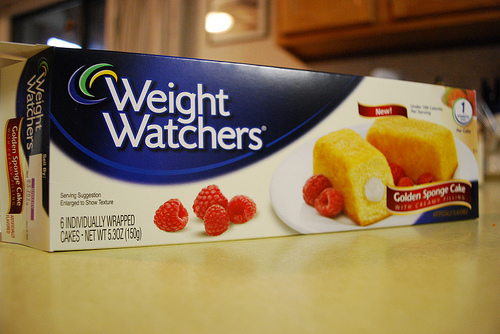
Yup, it's a diet twinkie.


Several years ago, Weight Watchers introduced an alternative plan to the “points” system.  They called this alternative plan “Core.”  On the core plan, a dieter could eat his/her fill of certain whole foods (e.g. fresh and frozen fruits and vegetables, whole grain pasta and rice, lean meats, eggs, fat-free dairy products), but had to count foods consumed that were not on the core list (e.g. bread of any kind, alcohol, reduced or full-fat dairy products).  The core plan was a step in the right direction of consuming a primarily whole foods-based diet, but many people – dieters and nutrition professionals alike – felt it was too restrictive, especially with regard to fats, which were limited to two teaspoons (two teaspoons!) of oil a day.  As a future dietetics professional, I find myself repeating that no one should have the goal of attaining a “perfect” diet (not that such a thing exists), but should instead work toward a moderate diet.

Weight Watchers, you have heard our plea!  In a move back toward a more balanced diet, the company has introduced the Points Plus system.  Points Plus attempts to marry the flexibility of the old Points program with the whole foods focus of Core.    


The Points Plus system is unique in several ways:

  • Higher point allotments: Dieters are given a higher daily point target, which means they can eat more on a daily basis.  While this may translate into a slower rate of weight loss, it’s a positive step because consuming too few calories not only slows down the basal metabolic rate (your “metabolism”), but also contributes to feelings of deprivation.  And we all know what happens when you start feeling deprived:


  • No rollovers: In the past, dieters had a weekly “bank account” of 35 extra points, which they could use or not use at their discretion.  The idea behind rollovers was that we are hungrier on some days than on others. The problem is that these “flex points” allowed dieters to save up for a binge, instead of spacing them out and using them as needed.  Without rollovers, it will be easier to adopt consistent eating patterns.

  • Fruits + Veggies = 0 points*: You heard me right.  In the past, fruits and veggies had points values just like every other food; i.e., they counted toward your daily point target.  Therefore, unless you already loved produce, there was little incentive to choose an apple when, say, you could eat a small piece of candy for the same amount of points.
*Except for certain items, including avocados, potatoes, and corn.

  • Increased emphasis on whole foods: Going along with the new position on fruits and vegetables is a new position on processed foods.  In the past, a 100-calorie apple and a 100-calorie cookie would both have set you back 2 points.  Now, however, the apple is “free” (0 points) and the cookie will set you back not 2 but 4 points.  This harder stance with respect to processed foods is designed to encourage increased consumption of whole foods, including fruits and vegetables, whole grains, low-fat and fat-free dairy products, and lean proteins.


Just as many dieters are excited about the new Weight Watchers program, some are frustrated by the changes.  What do you think of Points Plus?

Saturday, December 4, 2010

Cold food: It's hot, hot, hot!


Around this time each year, things can get a little dreary.  School picks up, I get less sleep even though there are more hours of night than day, and I have little time and even less inspiration to cook.  Plus, have you seen the produce aisle lately?  Unless you can get yourself to a Whole Foods, the pickings are slim.

So how can we keep our fruit and veggie intake going strong all winter long?  (You know I enjoyed that rhyme.)

The answer, my friends, is in the freezer aisle.

A thing of beauty, no?


Unlike canned fruit and vegetables, frozen produce is as healthy as fresh—and often healthier. This is because produce is frozen at the peak of freshness, when nutrients are at optimal levels.  Unlike pasteurization or preservatives (methods used to ensure the safety of canned foods), cold temperatures do not degrade the nutrients.  And the best part?  Preparation is as simple as pressing “start” on the microwave.  Ding!

Here are some ways to incorporate frozen produce into your diet:

Vegetables
  • Toss a handful or two into a saucepan of tomato sauce
  • Bulk up stir-fries and curries
  • Serve as a side dish, with a squeeze of lemon juice and/or a dash of your favorite spice
  • Nuke one package plain chopped spinach and one package creamed spinach; mix
  • Pre-seasoned frozen vegetables: pure genius and completely idiot-proof


Fruits
  • Heat gently and spoon over waffles or pancakes
  • Stir into lowfat plain greek yogurt
  • Eat frozen right out of the bag!


 Now you can get all the fiber and antioxidants you need to stay slim and healthy during these cold months.  ¡Salud!

Monday, November 29, 2010

The Dirty Dozen

“Should I eat organic produce?”


This is a question I get all the time, and it’s one that yields different opinions from different people.  Even among R.D.s, there are some who advocate for a mostly (if not completely) organic diet as well as those who are doubtful of the potential benefits of organic foods in light of their high price point.  So who’s right?

That is the question.  Relatively speaking, we have only recently begun to develop an awareness of the presence of pesticides in our food supply.  Therefore, few longitudinal (across time) studies have been conducted that assess the relationship between pesticides and our health.  In the next fifty years we will have more definitive evidence, but for now, what can we do?

The Environmental Working Group, a nonprofit organization that focuses on public health, examined 100,000 produce pesticide reports from the United States Dept. of Agriculture (USDA) and the US Food and Drug Administration (FDA).  From these reports, they identified the twelve most contaminated fruits and vegetables.  These produce items, dubbed the “dirty dozen,” contain 47-67 different pesticides per serving.  Try to buy them organic.

The Dirty Dozen

Fruits
Peaches
Strawberries
Apples
Domestic Blueberries
Nectarines
Cherries
Imported grapes (most come from Chile)

Vegetables
Celery
Lettuce
Spinach, Kale, Collard greens
Sweet bell peppers
Potatoes

The good news is that plenty of produce contains lower levels of pesticides.  Save your money and buy the conventional (non-organic) version of bananas, avocadoes, asparagus, sweet potatoes, onions, and more.  For a complete list, go here.

Don't sweat the sweet potatoes!


And remember, whether or not you choose to buy organic fruits and vegetables, more matters!


Sunday, November 28, 2010

Tea time

Tonight I am going to share a secret with you:

Licorice and peppermint tea.


Trust me, this one's a winner!  Here's the rub: Licorice root is naturally sweet -- sweeter, in fact, than sugar.  Together, the two flavors totally complement each other: at first you get the invigorating taste and scent of peppermint, and then the sweetness from the licorice.  All this from plunking two tea bags in a mug of boiling water.

It's genius.  I know.  You're welcome :)

In case you were wondering, I swear by Bigelow peppermint tea.  It's the most pungent mint tea I've tried, and it's great either by itself or with...

  • Stash licorice tea (pictured above)
  • Yogi Egyptian licorice tea (often sold in the organic/natural foods section of the supermarket)
*Note: The people at Yogi tea are one step ahead of me and already make an Egyptian licorice mint tea, which saves you the trouble of using two tea bags.  If only I were so smart!

It's back to the blustery winds of Boston tomorrow, where Major Homework will commence.  Something tells me I'm gonna need to break out the puffy coat.  Good thing I have something warm to drink!

Publish Post